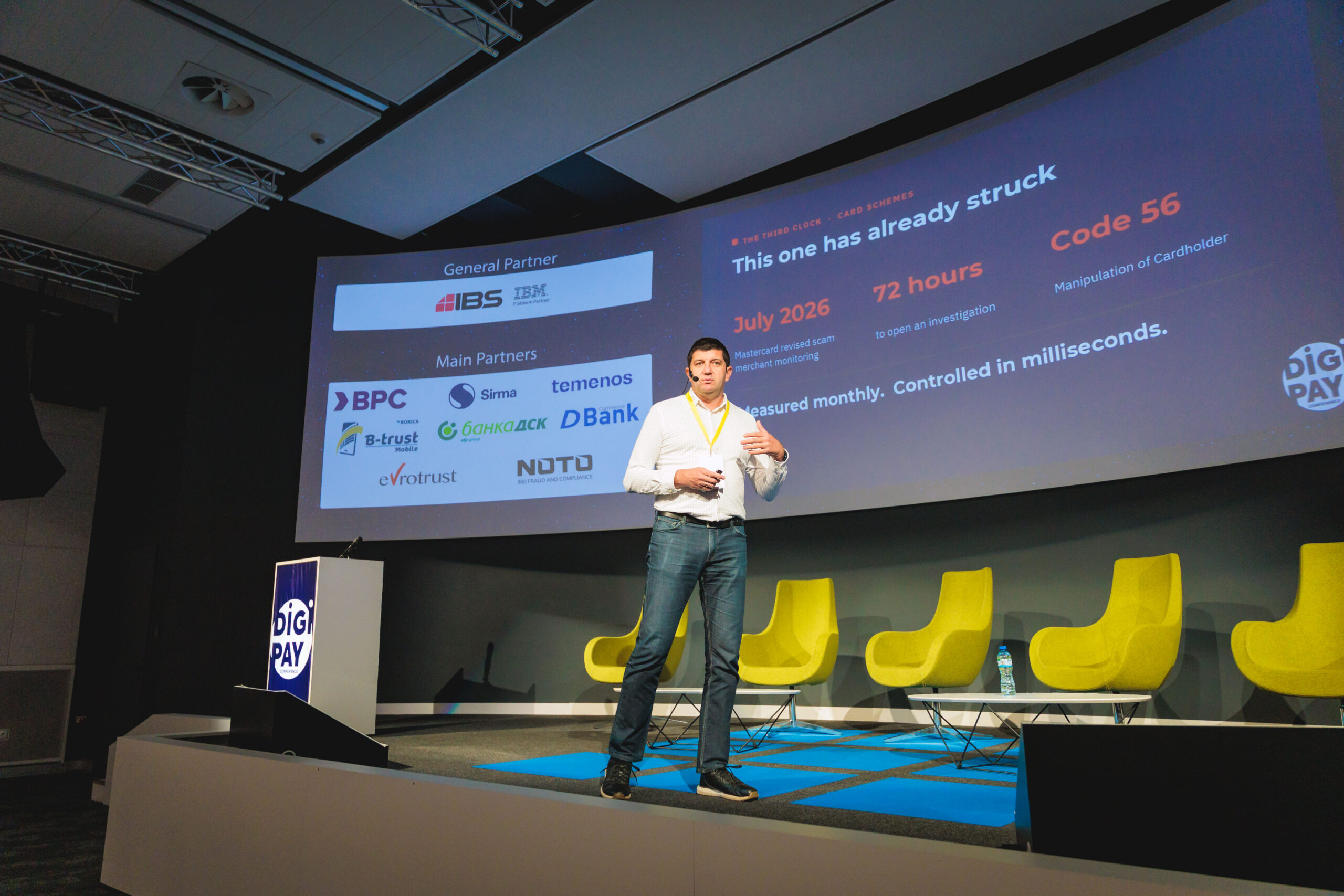
Representatives of the European Commission, the Bulgarian National Bank, banks and international companies met in Sofia to discuss new European regulations, the digital euro, AI agents and the fight against financial fraud.
The coming year will be crucial for cross-border payments in Europe. The EU’s financial sovereignty, agentic payments and the rollout of digital wallets were among the key topics at DIGI PAY 2026, a leading conference on digital payments held in Sofia. A central theme throughout the discussions was the need for financial innovation to go hand in hand with security and consumer trust.
Astrid Cousin: The European Commission’s Vision Is for Instant Payments and the Digital Euro to Complement Each Other
“Our vision is that instant payment-based solutions and the digital euro will complement each other and together provide autonomous pan-European payment solutions,” said Astrid Cousin, from the European Commission’s Directorate-General for Financial Stability, Financial Services and Capital Markets Union (DG FISMA), during the conference’s opening session.
European payment sovereignty is being advanced through both public solutions, such as the digital euro, and private payment solutions, such as Wero, the platform developed by the European Payments Initiative (EPI).
Instant payment solutions are already having a tangible impact on the EU payments market, according to figures published by the European Payments Council (EPC). A total of 2,820 payment service providers have joined the SEPA Instant Credit Transfer (SCT Inst) scheme, managed by the EPC. This represents 80% of payment service providers across Europe and more than 92% of those in the euro area, Cousin noted.
Meanwhile, instant payments’ share of all credit transfers increased from 13% in 2022, when the European Commission presented its proposal for the Instant Payments Regulation (IPR), to 38% in the second quarter of 2026, she added.
Cousin also highlighted the growing importance of AI-powered agentic payments. While these offer significant potential, they also raise important questions around authentication, security and the allocation of responsibility.
Ludovic Francesconi, EPI: Europe Must Overcome Fragmentation in Its Payments Market
Europe’s payments market remains highly fragmented, giving global companies from outside Europe a competitive advantage. This was the message from Ludovic Francesconi, Chief Member & Strategy Officer at the European Payments Initiative (EPI), one of the conference’s special guests.
According to Francesconi, the creation of the European Network for Payments (ENP) will help establish interoperability between European payment solutions in 2027, making cross-border payments easier. Wero, the digital wallet developed by EPI, already has 60 million registered users and reaches more than 80% of consumers in the markets where it operates.
Francesconi stressed that the future digital euro should complement private-sector payment solutions rather than duplicate them. At the same time, the rise of AI-powered payments will require European legislation to adapt and new mechanisms to be introduced to protect consumers.
One of the most engaging discussions focused on the practical implementation of agentic payments. The session brought together Nikolay Spasov, CEO of D Commerce Bank; Dimitar Dimitrov, Co-founder of the Bulgarian E-commerce Association and CEO of SocialScore.io; and Ivan Hadjov, Director of Business Development at Mastercard. The discussion was moderated by Merdihan Ismailov, Vice President, Products & Solutions, FinTech, at Sirma Group.
Artificial intelligence, personalised investment solutions and digital platforms are reshaping the wealth management market, emphasised Noah Krähenmann, Global Managing Director of Wealth Management at Temenos, a global banking technology provider, and Fabrice Gouttebroze SVP International Sales, VP of Core Banking System Temenos Practice, Sirma Group in their
presentations to the DIGI PAY 2026 audience.
According to the figures presented, the assets managed by Bulgarian pension funds reached €15.82 billion in the first quarter of 2026, creating opportunities for the further development of investment services. Experts noted that banks could expand their customer base through digital platforms combining automated investment solutions with personalised advice. Despite AI’s
potential, investment decisions must remain traceable, risk-aware and subject to human oversight to safeguard clients’ assets.
Bulgaria Plans to Develop Its Digital Identity Wallet by 2027
The development of Bulgaria’s digital identity wallet under the European Digital Identity Wallet (EUDI Wallet) framework, together with its integration into the European system, is expected to be completed by October 2027. This was announced by Kiril Gaberov, Director of the newly established Directorate for Digital Transformation and Automation at the Ministry of Innovation and Digital Transformation, in his first public address on the subject at DIGI PAY 2026.
According to Gaberov, the state will own the wallet, and the government has already issued a mandate for its development. Public consultations are also planned, while a legislative proposal for its establishment has already been opened for public consultation.
Prof. Georgi Dimitrov, Chairman of the Board of Directors of Eurotrust, argued that the government should discuss progress with the business community on a weekly basis. He noted that companies already have relevant experience and are ready to propose effective solutions.
The success of the EUDI Wallet will depend not only on technology but also on interoperability between national systems, common European standards and business participation, explained Alexander Stanev, Head of the Business Division at BORICA.
Stanev also stressed the importance of cooperation between the public and private sectors, pointing out that several digital wallets are already operational. He encouraged people to test these solutions and provide feedback to help improve them.
Dimitar Mutafchiev, Security Director at DSK Bank, highlighted the importance of secure identification and the practical application of new technologies in the financial sector. He stressed, however, that these developments require a consistent policy and clear messages from the government.
According to Mutafchiev, digital wallets have potential far beyond administrative services, although differences between national regulatory frameworks remain a significant challenge. This is also one of the key issues facing Europe as it works towards a more integrated digital identity ecosystem.
Instant Payments and AI Require Financial Fraud to Be Detected in Milliseconds
The growth of instant payments means banks must move from periodic checks to comprehensive, real-time monitoring. This was emphasised by Svilen Stanchev, Sales Director at IBS Bulgaria, during DIGI PAY 2026. According to Stanchev, new European regulations require financial institutions to reconcile transaction speed with security and the traceability of funds. Where regulatory requirements set a timeframe of under 10 seconds and payment scheme rules require completion in under 5 seconds, effective risk assessment demands that checks be carried out in milliseconds.
Another special guest was Inge den Hollander, Board Member of ACFE Netherlands, the Dutch chapter of the Association of Certified Fraud Examiners. Through a live demonstration, she highlighted the growing risks of identity theft involving deepfake technology and artificial intelligence. She presented a case from the Netherlands in which a fraudster had opened 47 bank
accounts using fake biometric identification. Experts stressed the need for multi-layered security, payee verification and round-the-clock transaction monitoring. The ability to block suspicious funds quickly and exchange information between banks and relevant institutions remains critical.
In 2025, approximately 38 million instant transfers were carried out in Bulgaria, representing year-on-year growth of 69%. The rapid development of this market calls for a new approach to financial fraud, based on integrating fraud detection systems with anti-money laundering measures — an approach known as FRAML. This was among the topics discussed by international experts at the conference.
More than 350 financial services, fintech and cybersecurity professionals from Bulgaria and abroad attended the conference, which is dedicated to advancing secure and accessible in-person and online payments. The programme combined practical discussions with real-world case studies. Thanks to the partnership with the Association of Certified Fraud Examiners (ACFE Bulgaria), participants receive a certificate of training.
The conference is supported by leading Bulgarian industry organisations, including the Bulgarian Fintech Association, the Bulgarian E-commerce Association, the Bulgarian Association of Software Companies (BASSCOM), the Bulgarian Entrepreneurial Association (BESCO), the Bulgarian Cybersecurity Association and ISACA Sofia Chapter. VisitSofia, Sofia’s municipal tourism enterprise, was a special partner this year. Next year, DIGI PAY, the conference dedicated to secure and accessible payments, will celebrate its 10th anniversary, offering new opportunities for knowledge-sharing and collaboration across the industry.